

I last posted about my curly girl adventures five weeks ago, but in that relatively short time I’ve made some progress and learnt so much that I figured I’d share my findings. I’m taking you on this journey with me!
In terms of progress, my hair is looking better. And by better I mean: my curls are increasingly more defined. This is my best hair day so far…
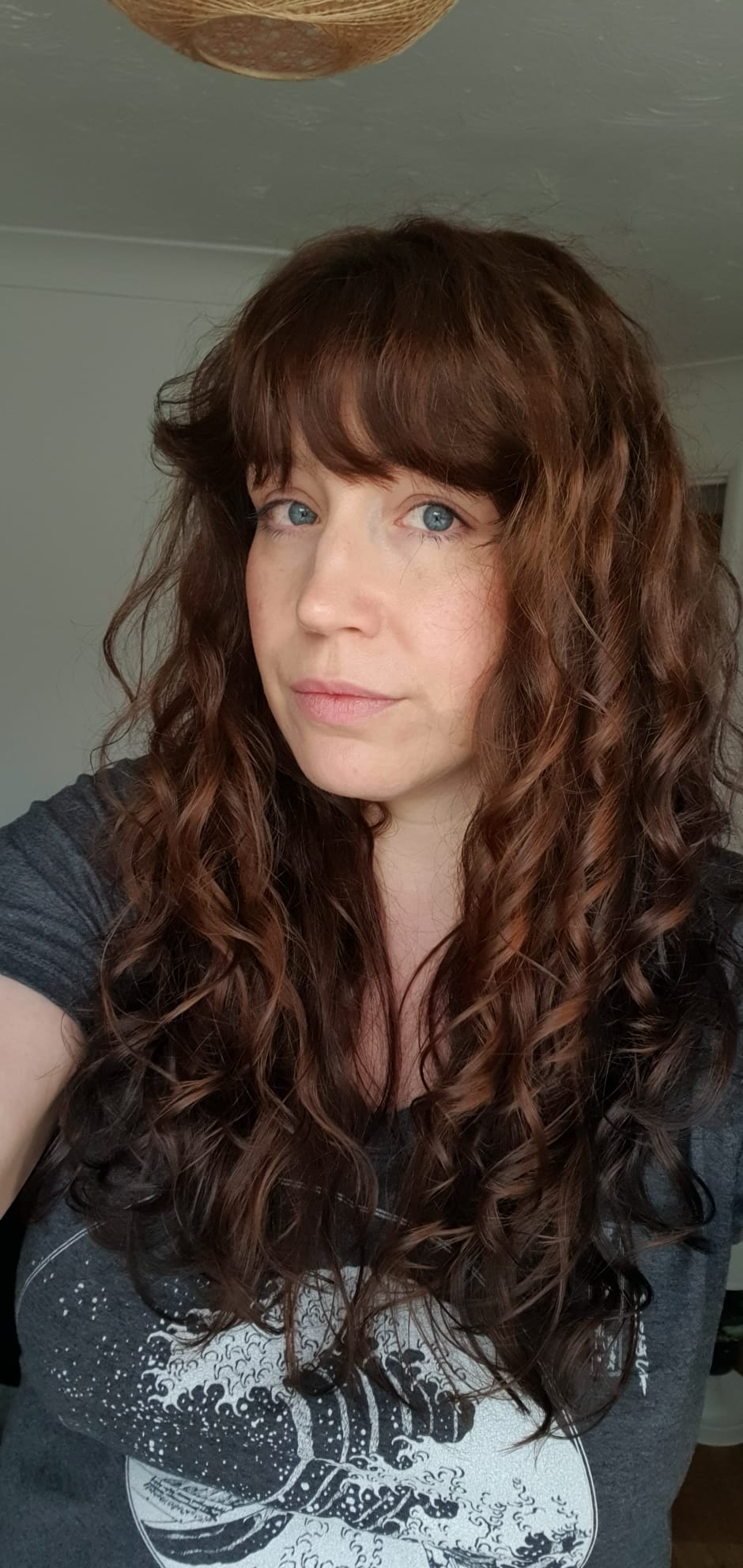
I’d heard online about the ‘transition phase’, and I suspect that’s where I’m at right now. The more I encourage my curls to form, the more willingly they seem to do so. The right products help, too, of course – removing silicones from my routine has allowed my curls to curl. I’m getting better at figuring out what products work for me.
In terms of lessons learnt, here’s what I’ve discovered so far:
Lesson #1: You probably don’t need to worry about protein vs moisture balance, especially at the start of your curly hair journey
Unless your hair is very damaged (because you bleach your hair, spend a lot of time in the sun, swim regularly in chlorinated pools, heat style on the daily, etc) you don’t need to worry about this. There’s no harm in making sure you’re using the right conditioning products for your hair (as it might be on the dry side initially, once you cut the silicones). But unless your hair has obvious damage, chances are your hair is already pretty balanced. If so you’ll find (as I did) that adding protein leaves your hair dull and straw-like (this is known as protein overload), and going overboard with the moisture (cowashes, or deep conditioning masks) leaves your hair lacking curl definition (your gel will also struggle to form a cast on over moisturised hair). In short: unless your hair is really damaged, don’t worry about this just yet. (And if your hair really IS damaged, then you’ll want to try something like the Curlsmith Bond Curl Rehab Salve which is a bond repair treatment containing protein.)
Lesson #2: Most curly girls aren’t strictly following the Curly Girl Method
Lorraine Massey actually created the Curly Girl Method for Black hair, which is typically thicker, more coarse, and needs those heavy oils for taming tresses and frizz control. This means that, for many (and especially those with fine hair), following CGM strictly means that their hair becomes nightmarish quite quickly.
Some hairfluencers use stronger sulphates like SLS for clarifying, some re-introduce silicones into their routine for added shine, some never use cowash. Ultimately, you will need to tailor your haircare routine to suit you and your hair, but the Curly Girl Method can be a useful jumping-off point.
Lesson #3: You might need sulphates in your routine
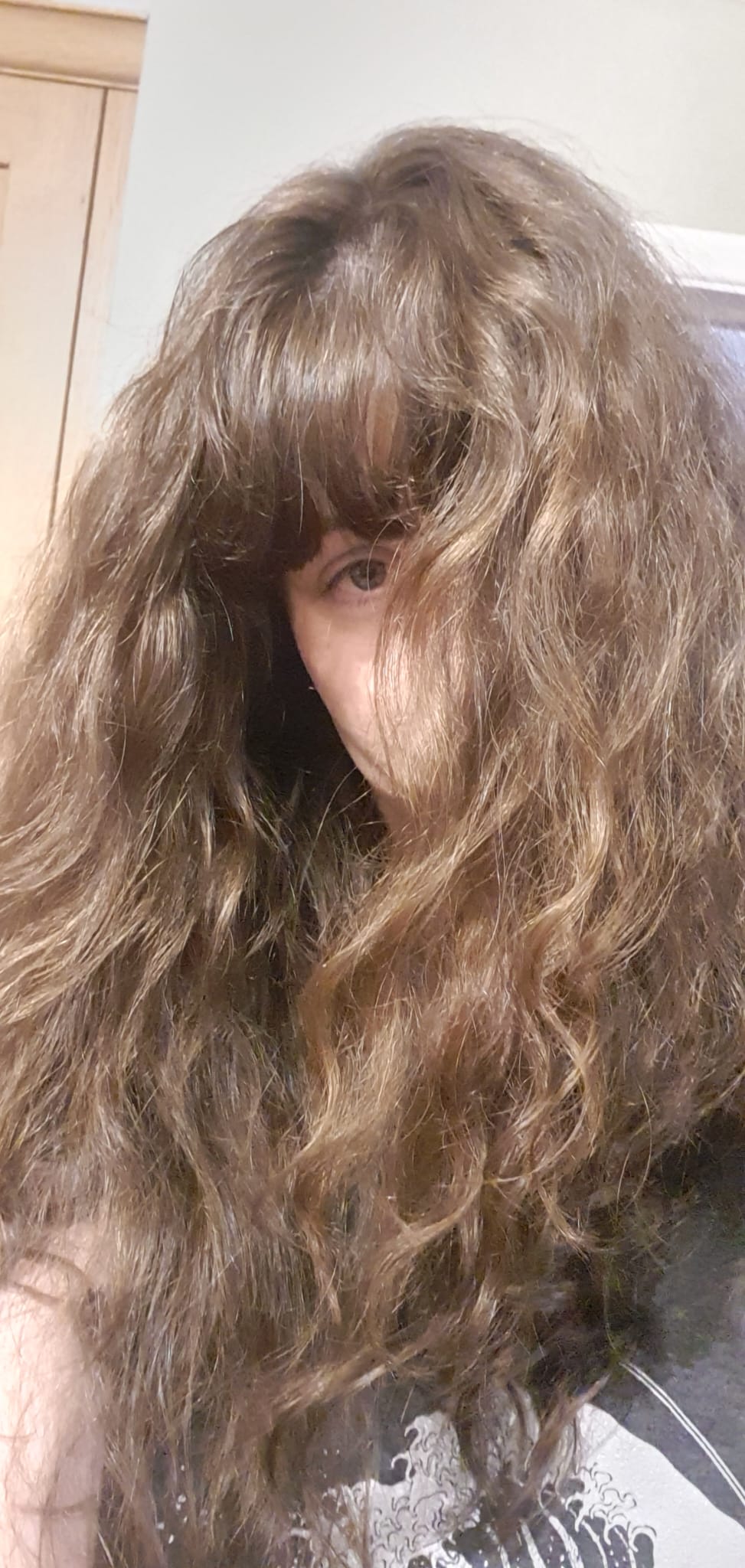
One of my major breakthroughs came after I realised I needed SLS in my routine. I have fine/medium hair that is prone to build-up and, after struggling for months with several sulphate-free clarifying shampoos, I eventually used a shampoo containing SLS. Suddenly my hair was a MILLION times better – my curls started to form again, and my hair was no longer fluffy (a result of product build-up). Here’s my before and after:


If you’re on the curly path and struggling with lacklustre results, I recommend spending £3.25 on Simple’s Gentle Care Shampoo that contains SLS but is otherwise a gentle formulation. I also love the Garnier Hair Food papaya shampoo (used in my ‘after’ photo, above); after all my product experimentation is over, I strongly suspect this will be the ‘clarifying’ shampoo I end up leaving in my routine.
Lesson #4: Not all silicones are created equal
The official Curly Girl Method takes a hard line when it comes to silicones, and excludes them from their method entirely, but I know some curlies who still use them.
I choose not to include silicones in my routine right now because most silicones you find in shampoos made by the big brands (L’Oréal, I’m giving you the stink eye) contain silicones that aren’t water-soluble. This means that they are quick to build up on the hair, hard to remove, and can leave your hair feeling greasy. Because of the way they sit on the hair shaft, they can lock out nourishment or benefits from other products you might be using. They can also leave your hair more dry and brittle in the longer term, because they make it harder for moisture to penetrate the hair shaft. My hair was dry after removing silicones from my routine for this reason (it has since recovered).
I experienced silicone build-up prior to embracing my curly hair, too – I would end up with greasy roots, dry ends, and needing to wash my hair daily. Now that I’ve switched to silicone-free products, my hair stays cleaner for longer.
When it comes to silicones, you have (in my humble opinion) two decent choices:
- remove them from your routine entirely and focus on giving your hair the emollients and conditioning agents it needs (the approach I’m opting for right now), or
- use products that contain water soluble silicones. Here’s a list of the good vs the bad silicones (credit to Manes by Mell) and this blog post goes into more detail about silicones.
Water soluble silicones:
- Cyclomethicone
- Dimethicone copoyol
- Laurl methicone copolyol
- Any silicone with PEG as a prefix
Non-water soluble silicones:
- Amodimethicone
- Amodimethicon
- Ceteraryl methicone
- Dimethicone
- Dimethiconol
- Pheryl trimethicone
- Stearyl dimethicone
Silicones aren’t inherently bad, and if you’re someone with very damaged hair some silicones can help prevent further damage because they coat the shaft and reduce friction between strands. They might be a useful (if perhaps only temporary) tool while your hair recovers from, say, bleach damage.
If you decide to move away from them, though, the transition to silicone-free can be rough. Silicones, by adding a smooth layer to each hair strand, can make your hair feel thicker and look more shiny. And because they coat the strand, they can also tackle frizz quite effectively. My hair has more body and volume these days, but is more prone to frizz and looking ‘fluffy’ unless I’ve done a good job in selecting the right stylers (e.g. a leave-in or curl cream, and stronghold gel that leaves a good cast). In future, this shouldn’t be the case – I should see, over time, an improvement in hair health and manageability on the days I don’t use stylers.
If I were to reintroduce any silicones into my routine in future, I would make sure to wash them out using a sulphate shampoo (something containing SLS) and I would only use them occasionally in a styler, e.g. an anti frizz serum, or a hair cream designed to protect against humidity. Right now, I’m keen to see if I experience what other curly girls say they experienced during their hair journey – a visible improvement in hair health after removing silicones and using sulphates sparingly.
Lesson #5: Start with the expensive products (yes, really!)
Not just the (relatively) expensive ones, but the ones that are recommended repeatedly online by the people trying these products for a living (a.k.a. the hairfluencers). This advice might surprise you, but I’ve ended up spending so much more on haircare trying to find cheaper versions of higher end products. When I say expensive I mean brands like Curlsmith as opposed to TRESemme. You’re much better off with a brand that specialises in curly hair than a better-known brand like Pantene or Aussie who claim they’ve formulated something for curly hair. Garnier is the only exception to this rule I’m aware of: the Garnier Hair Food range is decent for curly hair (and many of those products are CGM-approved), but overall I would say: do not wander down supermarket aisles scooping up any product that says it is suitable for curly hair. There is a consensus online typically about what is good and what’s not. Take the advice.
Another upside of this approach (aside from saving time and money) is that if you’re not getting the results you want, you’ll know it’s a technique or product amount problem. There are so many variables when it comes to figuring out your curly hair that it makes sense to try and remove one (product quality).
I can recommend starting with the Curlsmith Shine range – you can often find the kit discounted on sites like Look Fantastic, or you can buy the travel versions (Curlsmith do 4 for 3 on these, totalling £30 to try the whole system). I wouldn’t recommend starting with the moisture (orange) or protein (purple) ranges – these are products for people who know what their hair needs, and at the beginning it’s very difficult to know. I got to protein overload by using too many products in the purple line, product build-up by not using SLS, and moisture overload by cowashing my hair too frequently. The silver lining here is that at least I know what these states look like on my hair now.
Lesson #6: Diffusing technique
You’ll commonly see ‘hover’ and ‘pixie’ diffusing in tutorials, but I found that I needed the ‘cupping’ technique, and to ‘plop’ (rest) my hair on a surface (usually the bed), placing the diffuser on its side to dry my hair. Fine hair is prone to wonky curls during the diffusing process, especially if you’ve not managed to get a decent gel cast, so taking a more careful approach here will really pay off. Gena Marie demonstrates what I mean perfectly here and WavyCurlyAli demonstrates what I mean when I refer to ‘cupping’.
Don’t forget that diffusing upside down will give you more volume. You might want more volume, you might not, so tailor your approach accordingly.
Lesson #7: Keep a journal
I was so resistant to this at first. I didn’t want the hassle or the overhead, I thought I could remember all the products I used and the results I’d gotten from them. After 10 days I realised how naïve I was. I now have a digital journal in OneNote that I upload photos to, but if you prefer pen and paper, Hanz Curlz does a lovely hardback one.
Journaling, in my experience, also protects against a kind of ‘hair dysmorphia’ where you think you’ve made zero progress with your curls but you are, in fact, seeing improvements. I only know how far I’ve come because I have photo evidence.

Lesson #8: Know what each product is for
This probably sounds overly simplistic, but getting this clear in my mind helped hugely.
Shampoo: cleansing. That’s all it needs to do, and it needs to do it well. Shampoos that try to combine some kind of treatment with a cleanser are not worth the money (according to most experts online, including the Blowout Professor).
Current favourites: Only Curls All Curl Cleanser (felt quite drying to me at first, but results are always good), Umberto Giannini Scalp Restore Shampoo (contains pineapple extract so can feel a bit tingly on the scalp, but my curls seem to love it), Curlsmith Shine Shampoo (very gentle, very effective – best results I’ve ever had).
Conditioner: adding moisture. Your hair might need more, it might need less, but we all need it. And we should only leave a conditioner in our hair if it is formulated for that purpose.
Current favourites: Garnier Ultimate Hair Food Papaya 3-in-1 (my inexpensive go-to, which I use on days when I can’t be bothered to style my hair), Only Curls All Curl Conditioner (smells delightful and is lovely to use), Umberto Giannini Scalp Restore Conditioner (great slip, great conditioner – Hanz Curls is a fan of this range too), Curlsmith Shine Conditioner (gives just the right amount of moisture, best results I’ve ever had).
Curl cream / leave-in conditioner: moisture and definition. I always get better results with (the right) curl cream. This contradicts what I said in my last post (forgive me), after I was told by a curl specialist that I didn’t need a curl cream. I disagree, as do the hairfluencers online. All of them use either a curl cream or a leave-in. And hair expert the Blowout Professor says everyone (even those with straight hair) should be using a leave-in conditioner every wash day to keep moisture in our hair.
Current favourites: the Curlsmith Shine Cream and the Curlsmith Hold Me Softly Style Balm. Both of these are very concentrated so should be used on very wet hair and in small amounts at first. It’s easy to go overboard with curl cream in general, but in particular the Hold Me Softly Style Balm is very concentrated so go easy (this is from the Curlsmith moisture range, which typically contains heavier moisturising ingredients like butters and oils).
Gel: for hold and definition. Without this, your curls probably won’t last the day, especially if you have fine, soft hair. Don’t be afraid of a stronghold gel, or a gel cast – if the product is a good one you won’t feel anything in your hair once you’ve scrunched out the crunch, and a gel cast is essential for preventing frizz and protecting your curls as they dry.
Current favourites: Umberto Giannini Curl Jelly Scrunching Jelly (popular for a reason! Medium hold, best gel cast I’ve had so far, and the packaging is aesthetically pleasing and tactile), Curlsmith Shine Jelly (a great gel for beginners – medium hold, but doesn’t form much of a cast). I want to try the Curlsmith In-Shower Style Fixer next, as this is recommended regularly online and is very strong.
Oil: for scrunching out a gel cast and sealing/finishing the ends of your hair. You need the tiniest amount – just 1-2 drops rubbed between your palms before you start scrunching.
Current favourite: Umberto Giannini Bonding Oil. I love this stuff; affordable, leaves my hair glossy, does a great job helping to scrunch out the crunch, and I love the packaging.
Mousse: volume, light hold. I don’t use mousse in my routine currently because I don’t like the texture on my hair (texture is useful for hold, though). I need a stronger hold than a mousse alone can provide, and I prefer that my hair doesn’t feel rough; I don’t like the grit and texture I get from a mousse.
Lesson #9: Keep tabs on what you’re trying
I have a whole separate OneNote doc for this, listing current favourite products, ones I’ve tried and hated, and what I’d like to try next. This is especially important if you’re going to dive into cheaper products to find what works for you – you’ll end up trying a lot to find what your hair likes.
Lesson #10: Brush style for best results
If you want max definition and less frizz, you can’t beat brush styling. I wish this wasn’t true, but it is. That said, you can take a lazy approach, you don’t need to be a perfectionist with this. I don’t section properly, I simply roughly divide my hair into four sections and brush style (with tension – Hanz Curls demonstrates this really well). The Bounce Curl brush (dupes can be found on Amazon!) is great for beginners, and the Tangle Teezer is another solid choice (I own and use both – you’ll see them recommended online a fair bit). Brush styling was my second major breakthrough. As I brush-styled my wet hair, I saw my curls forming before my very eyes. It was like having X-ray vision, being able to see my curl pattern in my wet hair.
Lesson #11: Just because it’s CGM-approved doesn’t mean it’ll work for your hair
This is particularly true, I think, of the heavier products designed for thicker coils. Many CGM-approved products contain oils and butters which are too heavy for fine hair. What works well for wavy hair won’t work for coily hair – those two hair types are so different. Thicker, tighter curls might need relaxing (weighing down) whereas wavy/curly fine hair will likely need lighter products that encourage curl formation.
I hope this helped, and if you have any tips of your own you’d like to share in the comments, I would love to hear them. Lord knows I need all the help I can get! 😉
 In Love With Colour